Maintainers Program Thesis [WIP]
Background
FOSS United Foundation is a non-profit organisation trying to strengthen the FOSS ecosystem in India. Our broad goals are -
- Supporting Individuals and Creators
- Nurturing FOSS Communities
- Enabling Organisations to meaningfully engage with FOSS
The foundation operates in three directions -
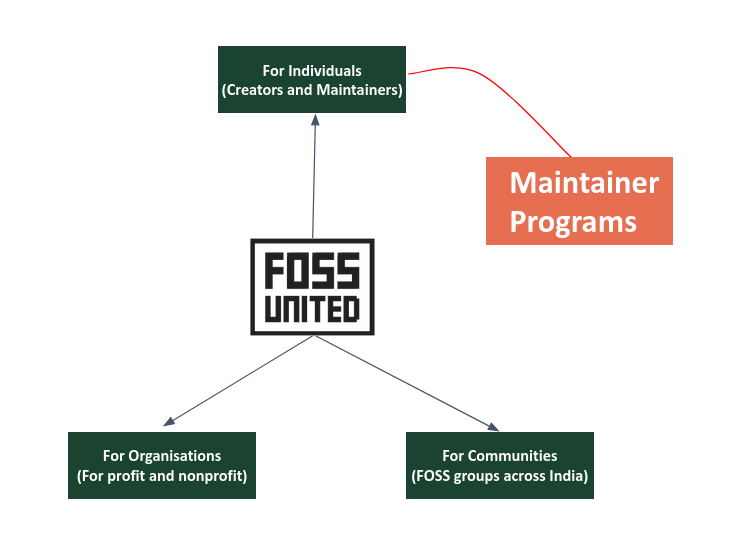
The global FOSS ecosystem rests on the shoulders of individuals. Behind almost every project that powers modern software infrastructure, there is a person or a small group of people who decided to build something and keep it alive. Foundations, Communities, Organisations and Companies all play important roles in the FOSS ecosystem, but the fundamental atomic unit of FOSS is the individuals who show up. After all, the foundations, communities and projects are all made of people.
This is why supporting these individuals is the foundation of our work. We have done a lot of brainstorming to determine how to name and frame this work, and have not been able to come up with the perfect word. "Developer" is too narrow, "Creator" excludes the people sustaining existing work, and "Contributor" is too broad.
The word “Maintainer” comes closest to what we mean. We define it loosely and deliberately, and explain why below.
Who is a Maintainer?
The word "maintainer" has a narrow technical origin. In software development, it traditionally refers to the person responsible for a codebase. However, the work of sustaining FOSS infrastructure extends well beyond code. Moreover, AI has made it extremely trivial to spin up a project. In an age where everyone can spin up their own alternative to a popular software, who is a “maintainer”?
For these reasons, we anchor this term not around artefacts, but an individual’s role in the ecosystem.
“A maintainer is anyone who takes ongoing responsibility for a FOSS or digital commons project. That could be writing code, reviewing contributions, managing releases, writing documentation, or stewarding the community around it. The project may be newly created or long-established. We do not define maintenance by the size of a project or the number of users, but the sustained, often unpaid labour that goes into keeping something useful alive.”
In practice, this includes -
- Creators of new FOSS projects
- Maintainers of existing FOSS projects
- Maintainers of upstream dependencies and infrastructure
- Individuals working on translations, localisation, accessibility, etc.
- Contributors to the digital commons ecosystem (open data, open science, etc.)
The problem
FOSS maintainers and projects face several challenges in their journey -
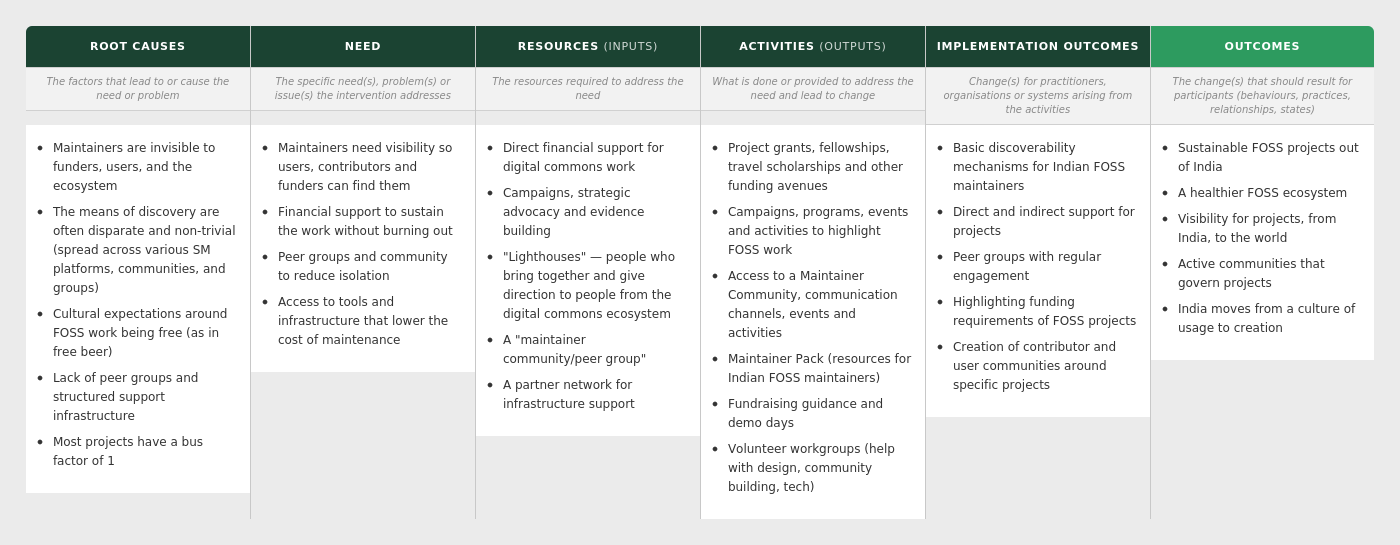
Disparate, non-trivial means of discovery - It is difficult to find adopters, contributors and users for a FOSS Project. Creators have to talk about their project across several channels ( HackerNews, blog posts, community groups, and Social Media platforms like Reddit, Linkedin, Twitter) to find eyeballs.
Lack of community - How does one find a peer group and a community for a niche that requires you to spend most of your time behind a screen?
Unpaid labor - Arguably, the most difficult challenge is to sustain yourself financially while working on a FOSS project. This happens because of several factors, but primarily because of the cultural expectation of FOSS work being free (as in free beer).
“Funding and financial sustainability, the lack thereof really, has been an increasingly hot topic over the last many years. Well, at least since cloud companies began making massive profits directly repackaging FOSS projects built by hobbyists and communities. The rise of the "open core" model and the unfortunate license changes in many good open projects recently, are clear signs of this growing turmoil. Many potential solutions seem to be emerging and evolving—commercial services, Venture Capital (VC) funding, and programs like GitHub Sponsors[↗], Open Collective[↗], FUTO[↗], Polar[↗], and Buy me a coffee[↗], amongst others. That said, Python libraries raising massive amounts of VC funding in quick time does not look like a healthy trend.”
We have tried looking at these problems from a theory of change lens
Maintainer Programs
Maintainer Programs is our initiative to support Indian FOSS project maintainers across the breadth of their entire journey, from getting discovered to becoming sustainable.
Premise
The foundation should treat its relationship with a maintainer not as a one-time interaction but as a long-term commitment to the health and sustainability of their project and their ability to keep working on it. The program is born out of our learnings from the grants program, and will subsume project and individual grant initiatives.
As part of the Maintainer Programs, a maintainer goes through the following stages.
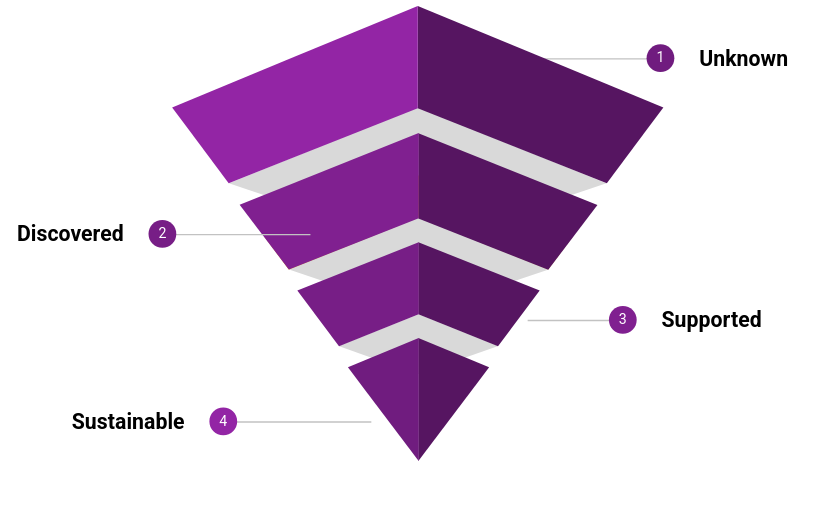
Note that this is not exactly a funnel, and not every maintainer needs to be “supported”. Our goal, however, is to continue expanding this structure.
To give some numbers, we expect that
- There are 100s, if not thousands, of individuals doing great FOSS work in India who are unknown to the FOSS community.
- We have discovered around 200 of them just over the last year. Some of these individuals are listed on forklore.in
- We have supported around <50 people over the past 6 years.
- There are <10 sustainable projects in the FOSS United Community.
The program itself operates on a 3-layer model, each building on the previous.
- Discovery
- Community
- Support
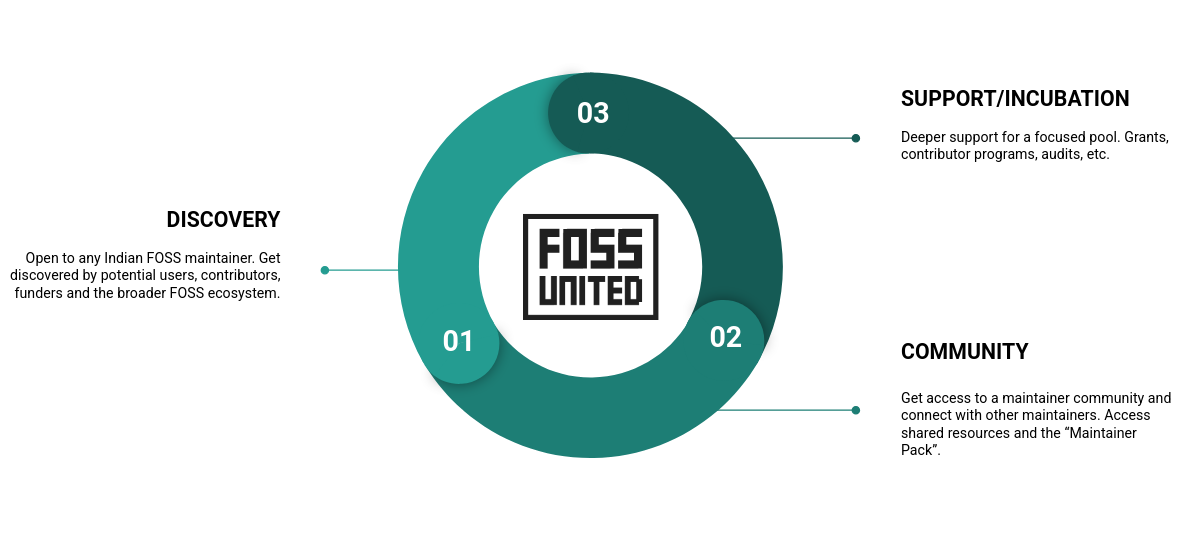
The discovery layer tries to provide visibility to Indian FOSS maintainers. In this layer, maintainers
- Get visibility into and inside the FOSS community.
- Get an interface with the FOSS United Foundation.
The foundation uses the following tools to help individuals in this layer -
- forklore.in - Folklore is a directory of Indian FOSS maintainers, and acts as the front door to everything Maintainer Programs.
- fundingjson.org - Adopted from floss.fund, the fundingjson experiment aims to highlight the funding requirements of Indian FOSS projects. We will use this to plug them into the FOSS Pledge and other such programs.
- Content and Campaigns - We highlight maintainers through campaigns ( #MeetTheMaintainers, #ForkloreFridays), blog posts, case studies and op-eds.
- Events - We are happy to provide visibility to Maintainers at FOSS United events, including flagship events like city conferences and the annual IndiaFOSS festival.
- Lighthouses - We use the term “lighthouse” to define people, communities and organisations that give a direction to bring people together (like a lighthouse!). These are folks who have created their own channels and small communities of people doing amazing work in the Digital Commons ecosystem. The foundation wants to continue finding such lighthouses and supporting them directly instead of having to look for the individuals who are already active in these communities.
The community layer, as the name suggests, is a community of Maintainers. Anyone in the Discovery layer can opt in to be part of this community (for example, when signing up on Forklore)
Broadly, this layer has two aspects.
The Community
- Mailing list and discourse channel for Maintainers
- Access to training sessions around security, accessibility, compliance, etc., organised by the foundation
- Community Calls and events for Maintainers (including Maintainer Summit that happens on the day before IndiaFOSS!)
- Access to the upcoming FOSS United Grants working group, and floss.fund discussions
Maintainer Pack
- Cloud Credits (We are working with various cloud providers to set up a credits program for Indian FOSS maintainers.)
- (Free/Discounted) access to various dev tools and software.
- Scholarships to travel to various events, free tickets to FOSS united events, and presence at the IndiaFOSS festival.
- Access to workshops and future Maintainer-specific programs.
To give an overview, in this layer, Maintainers get -
- Access to a peer group of fellow FOSS maintainers with whom they can interact.
- Deeper access to FOSS United Foundation staff and resources.
- Access to the “Maintainer Pack”.
- Help from the foundation’s staff and volunteer-run workgroups around -
- Design/UI/UX
- Community Building
- Marketing and Advocacy
- Technical guidance
The foundation uses the following tools to help individuals in this layer -
- Community Channels (Mailing groups, Discourse, IM)
- Partner network (organisations that can contribute tothe Maintainer Pack)
- Volunteers and Staff resources
Notably, this is the tightest layer of our program, and we expect most maintainers to stay here. Even projects that become grantees and get direct support from the foundation should eventually come back in this layer and continue engaging with the community. As some of these maintainers become more active, we hope this will help make the program more community-driven.
The support layer is where the Foundation invests significant time, resources, and effort in a project's growth for a small pool of projects.
Projects may usually reach out for such support, or the foundation may identify certain projects with potential and decide to support them. “Support” here can be -
Funds
- Grants and Fellowships (direct funding)
- Miscellaneous grants (eg, travel funding to events)
- Fundraising guidance (for eg, putting maintainers in touch with VCs and organisational funders)
Community Building
- Helping Maintainers build a community around their project
- Participation at FOSSHack (Partner projects), Season of Commits, and IndiaFOSS to help them find users, contributors, and hires.
- Organising dedicated events and user studies for the project
Infrastructure
- Sponsored compliance, security, and accessibility audits
- Hosting and infrastructure support
- Hardware and Cloud support (direct grants on top of the credits program)
Adoption
- We try to help these projects get adopted. This is a higher-order effect and difficult to measure.
- Travel grants to events where Maintainers can find people who’d be interested in their projects
- Press coverage
This layer is designed around the needs of a Maintainer, and new programs will be added based on the requests that come in. Naturally, projects in this layer get the most facetime with the foundation staff.
In this layer, the foundation makes use of all its resources to support Maintainers. We aspire to help projects in this layer reach sustainability.
If anything at all!
Our support towards FOSS projects has always been no-strings-attached. However, since the foundation operates on a limited amount of resources, we have to be very meaningful with where we direct them. The program should not be a unilateral transfer of resources.
The following are not requirements or conditions that you have to agree to when getting a grant, but some aspirations we have from Maintainers that benefit from our programs -
- Transparency and Visibility
- We expect to have some visibility into the project and what the maintainer has been up to during the duration of the grant.
- We will have periodic check-ins with Maintainers to discuss updates on the project, in addition to regular updates that they post on the forum.
- Community Engagement
- Grantees are expected to participate in the community, with at least one meaningful interaction each quarter. This could be a speaking arrangement at an event, a blog post, or just a forum update.
- Projects participating in Season of Commits or FOSSHack should engage actively with contributors who come through those programs
- We highly encourage projects to participate in the multiple activities that happen at IndiaFOSS (talks, devrooms, booths).
Reciprocity
- As projects grow and become more sustainable, we hope they will find ways to give back to the ecosystem that supported them.
- This could be through the FOSS pledge, mentoring newer projects, contributing directly to the Maintainer Programs, etc.
Lastly, the FOSS ecosystem fundamentally operates on trust, and trust goes both ways. We hope that Maintainers (especially grantees) will consider any pointers we have for them, based on our experience from talking to tens of other Indian FOSS projects.
After a period of time, Maintainers in the support layer “graduate” from the program. We classify them as mature projects that have come out of the Indian FOSS ecosystem.
While such projects may not qualify for direct support hereon, they will be the stories that we champion. A maintainer doesn't need to have gone through all the layers, but we hope that this model helps bring more projects to the “sustainable” stage. Graduating from the program does not mean that you are leaving the ecosystem. You are still part of the maintainer program structure, but you “choose your orbit” and decide how you want to continue engaging with the foundation, for eg, becoming an active part of the community, engaging with our organisation program verticals like hiring.
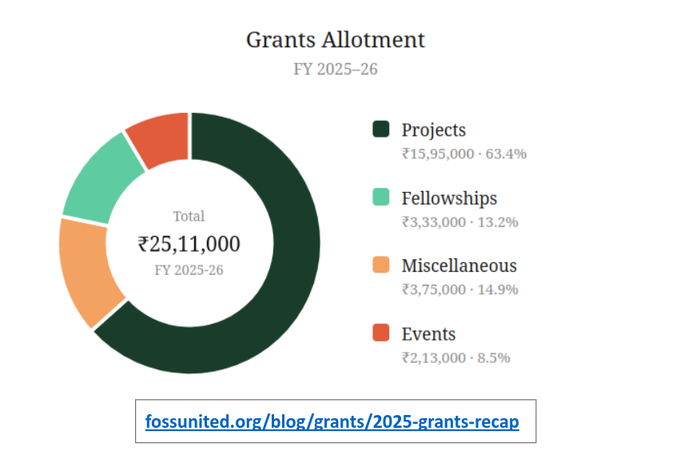
Last year, we deployed more than INR 25L across 28 projects, fellowships, and events. We exhausted the grants pool entirely, running an estimated deficit of 2-3L by the end of the financial year. We received ~200 applications and approved fewer than 15%.
India's FOSS ecosystem is growing faster, and we need to expand the quantum of our support to keep up with this pace. For FY 26, we are raising INR 50 lakhs to fund more projects, expand fellowships, and launch the Maintainer Pack.
You can contribute to Maintainer Programs in two ways -
Grow the grants pool
Fund Indian FOSS maintainers directly, or co-sponsor specific programs like the Maintainer Travel Scholarships (5L), Season of Commits (75k per fellow) etc.
Contribute to the Maintainer Pack
If your company can offer cloud credits, tool licenses, hardware, training, or even space for co-working, we'd like to put it directly in the hands of Indian FOSS maintainers. This is a concrete, low-friction way to support the ecosystem.
Check out our partnership deck here.
A lot more Indians will be creating FOSS this decade. We want to help them navigate and sustain their journeys.
If you’re an organisation that wants to be part of this journey, or a Maintainer looking for support, please reach out.