Skip to Main Content
Lightning Talk Beginner First Talk

Building at the Edge: Combining Open Hardware and ML in Student Projects

Proposal status is Rejected
Session Description

Most conversations about machine learning assume a server, a cloud API, or at least a decent laptop. This talk challenges that assumption. Over the past two years, I built two open hardware systems as part of my undergraduate engineering programme at VIT-AP University: MITRA, an autonomous rover running on a Raspberry Pi and ESP32 with real-time sensor fusion, and an adaptive wearable health monitoring system that performs ECG signal processing, QRS detection, and anomaly prediction entirely on edge hardware. Both projects started with a breadboard and a lot of uncertainty.

The talk walks through what it actually took to go from idea to working hardware: choosing the right microcontroller for the job, writing firmware in C and MicroPython, designing sensor pipelines that do not fall apart under noise, and deploying lightweight ML models (scikit-learn, Isolation Forest, Pan-Tompkins algorithm) in environments where memory is measured in kilobytes. I will cover the moments where things failed, what those failures taught me, and how open tools such as KiCad, ESP-IDF, FreeRTOS, and open datasets made the work possible without institutional resources or a research lab budget.

The core argument is straightforward: open hardware and ML are not separate worlds. A student with a 500 rupee microcontroller and access to open-source tooling can build systems that do real inference, real signal processing, and real physical actuation. This talk is for anyone who has wondered whether they have enough to get started. The answer is almost certainly yes.

What the audience will take away:

A concrete mental model for where ML can run on constrained hardware, a realistic picture of the student builder's journey including the unglamorous parts, and at least one reason to start their own project before the conference ends.

Speaker Bio:

Saurabh Patil is a final-year Electronics and Communication Engineering student at VIT-AP University, Amaravati. His work sits at the intersection of embedded systems, signal processing, and applied ML. He has built autonomous robotics systems using Raspberry Pi and ESP32, designed wearable edge devices for health monitoring, and worked across the full stack from PCB-level hardware to React frontends. He is a first-time speaker at IndiaFOSS.

Key Takeaways
  • ML does not need the cloud. Lightweight models like Isolation Forest and classical signal processing algorithms like Pan-Tompkins can run on microcontrollers with severe memory constraints. The talk gives concrete examples of what fits and what does not.

  • The right hardware choice changes everything. Knowing when to use an ESP32 versus a Raspberry Pi versus an STM32 is not obvious at the start. Attendees will leave with a practical decision framework they can apply to their own projects.

  • Open tooling is genuinely enough. KiCad, ESP-IDF, FreeRTOS, MicroPython, and open datasets covered every stage of both builds. No proprietary software, no institutional license, no lab access required.

  • Sensor pipelines are where student projects usually break. Noise, timing issues, and inconsistent readings are the real bottlenecks, not the ML model. The talk addresses this directly with lessons from building real ECG and IMU pipelines.

  • Failure is a design input, not a setback. Both projects went through hardware revisions, firmware rewrites, and dead ends. Understanding how to read a failure and respond to it is a skill that compound over time, and it is something you can only learn by actually building.

  • You can start with what you already have. A 500 rupee microcontroller, open-source tools, and a problem worth solving are enough to begin. The barrier to open hardware is lower than it looks from the outside.

References

Session Categories

Introducing a FOSS project or a new version of a popular project
Tutorial about using a FOSS project
Engineering practice - productivity, debugging
Community
Technology architecture

Which track are you applying for?

Open Hardware

Speakers
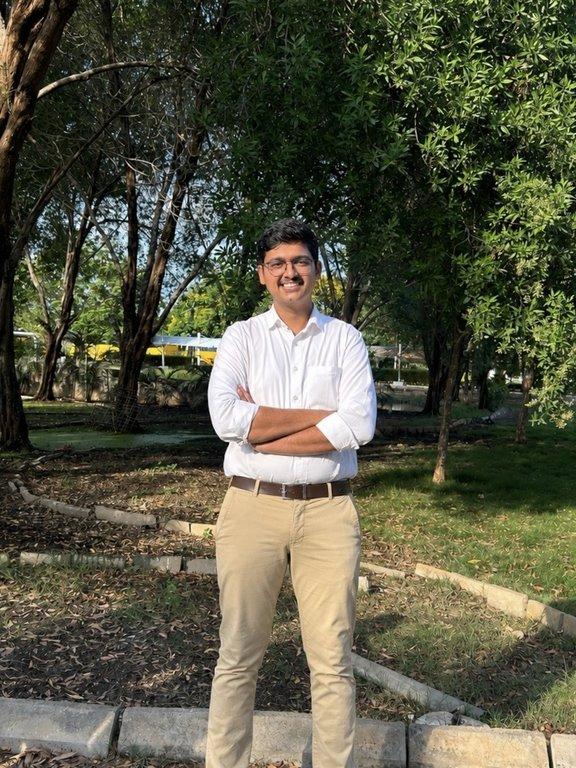
Saurabh Patil
Saurabh Patil Student | Vellore Institute of Technology, AP Campus

Saurabh Patil is a final-year Electronics and Communication Engineering student at VIT-AP University, Amaravati. His work sits at the intersection of embedded systems, signal processing, and applied machine learning on constrained hardware.

Over the past two years, he built MITRA, an autonomous rover using Raspberry Pi and ESP32 with real-time sensor fusion and navigation, and an adaptive wearable health monitoring system that performs ECG signal processing, QRS detection, and anomaly prediction entirely at the edge. Both projects were built using open-source tools including KiCad, ESP-IDF, FreeRTOS, and MicroPython, without institutional lab access or research funding.

He is a first-time speaker at IndiaFOSS and based in Maharashtra, India.