Skip to Main Content
Talk Beginner CC BY-SA 4.0

How to Build Long-Lasting Tech Communities That Thrive — A Playbook

Proposal status is Approved
Ashutosh Pandey
Ashutosh Pandey
Session Description

Most developer communities fail the same way: they start with a burst of enthusiasm, attract a core of deeply committed people, and then plateau. The outer ring never grows because the barrier to entry is too high. Or the opposite — the community stays wide and shallow, lots of followers, no one doing real work.

A model that works is concentric layers, each requiring progressively more commitment. The outer layers handle distribution and bring in casual interest. The inner ones build the committed core that sustains everything else. You need both, and you need to build them in roughly the right order.

This talk draws on direct experience building LLVM Social Bangalore (600 → 3,500 members, the world's largest compiler meetup), IICT (India's premier compilers workshop, now in its third year at IISc), SEGFAULT (India's first compiler hackathon), and Point Blank (a student tech community that has produced 20+ FOSS contributors and multiple Hackathon winning teams).

The Seven Layers

Layer 1 — Distribution. Pick a platform where your target audience already lives, not where you wish they were. Add a Discourse forum as institutional memory and a YouTube channel for recorded talks. Content compounds; chat archives don't.

Layer 2 — Open Source Programs. GSoC, LFX, and their India-local equivalents (KWOC, DWOC, SLOP) are underused community-building tools. They're not just about getting code written — they create contributors who feel ownership, and they function as a direct pipeline into deeper involvement. The operational prerequisite is a well-structured GitHub org with good-first-issue labels and a getting-started guide. Without that, motivated contributors bounce.

Layer 3 — Hackathons. Not all formats are equal. 24-hour onsite events produce shallow work in technically deep domains. Month-long online events have terrible completion rates. Hybrid hackathons — online rounds with mentored check-ins, in-person finals — consistently outperform both. SEGFAULT uses this model. Smart India Hackathon uses it. It works.

Layer 4 — Meetups and Tech Talks. Regular meetups are the connective tissue of a community. Mix invited talks with paper-reading sessions, low-agenda coffee meetups, and structured beginner workshops — they serve different audiences. LLVM Social Bangalore's Introduction to Common Compiler Tools series (10 talks, 800+ attendees online) brought more people into the community than any single conference.

Layer 5 — Schools and cohorts. A summer or winter school with real admission standards — and internship offers for top performers — reaches students who would never find their way to a research lab otherwise. No certificates keeps the cohort motivated.

Layer 6 — Conferences and Devrooms. IndiaFOSS devrooms are the most accessible entry point: FOSS United handles the logistics, organizers curate the room. A devroom is the proving ground before a standalone conference becomes viable.

Layer 7 — 1:1 Mentoring. The highest-leverage intervention for individuals. A student with a year of sustained mentorship from someone who's already done the thing they're trying to do ends up in a fundamentally different position than one who only attends talks.

The pieces don't have to happen in strict order — but they compound. Each layer makes the others easier to sustain.

Key Takeaways

Key Takeaways

  • A concrete, layered framework you can apply to any technical community — from a college club to a national conference series

  • How to pick the right platform for your audience, and why getting this wrong early costs you months

  • Why open source programs (GSoC, LFX, and their Indian equivalents) are one of the highest-leverage community-building tools most organisers never use deliberately

  • Which hackathon format actually works for technical domains, and which ones waste everyone's time

  • How to structure a meetup series so it serves beginners, practitioners, and researchers simultaneously — rather than optimising for just one group

  • When a devroom is the right move and when to attempt a standalone conference

  • How the layers compound: practical sequencing advice so you're not trying to run a conference before you have a community

References

Session Categories

Community
Talk License: CC BY-SA 4.0

Which track are you applying for?

Main track

Speakers

Akash Singh Devops | Sabi

I'm Akash Singh, known as SkySingh04 online. I specialize in DevOps, MLOps and Golang.

I currently handle all things related to DevOps and Infra at FinalroundAI, and work as a DevOps and MLOps Engineer at Sabi. I have previously worked as a DevOps Engineer at Aspora and Embeddings Co. where I worked with AWS, Terraform and Infrastructure as Code, and as a Backend Engineer at CloudSek with my work primarily focusing on Golang and microservices. I'm a Kubestronaut, holding all 5 CNCF Kubernetes certifications [CKA, CKAD, CKS, KCNA and KCSA] and a big believer in all things Kubernetes.

I am active within the Open Source community. I run my own open source community called Point Blank, organize the Cloud and DevOps devroom at IndiaFOSS, and was selected for Google Summer of Code 2024 with Keploy and the Linux Foundation Mentorship 2025 with LitmusChaos.

I was the team leader for Hackglobal Hackathon 2024 which happened in Singapore. I have also participated and won in 7 other hackathons, winning and getting podium finishes all through. I regularly volunteer as a mentor and judge for various hackathons as well. I also attended ACM Winter School 2024.

I have also actively worked as a teacher, trainer and international speaker, both professionally at SwipeGen and CodingZen, and during club meetings as the Team Lead at Point Blank as since I genuinely enjoy talking about tech and sharing my knowledge with peers and juniors alike.

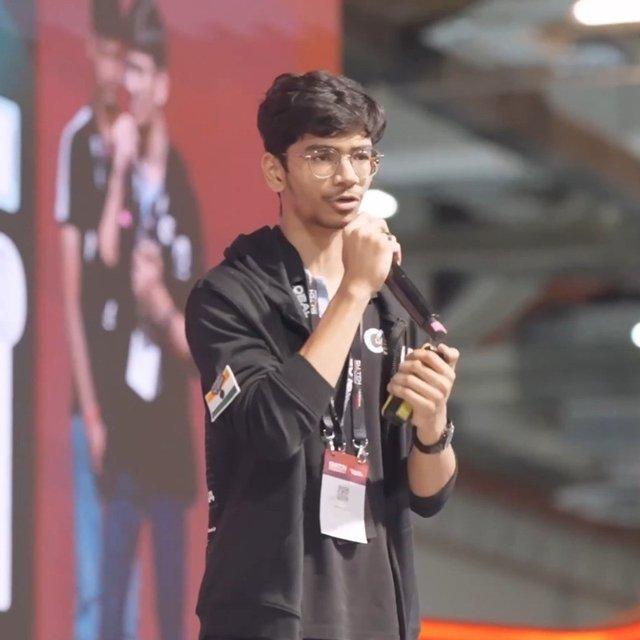
You'll find me with a mic in my hand emceeing on stage or winning Public Speaking Events across India

Akash Singh