Lightning Talk
Intermediate

The Browser Can Compute. You Just Never Asked It To.

Approved

Session Description

We don’t usually associate the browser with real computation. No one expects it to solve systems of equations, perform linear algebra with BLAS or LAPACK, or handle large-scale numerical operations — and yet, that’s exactly what it can do now. Using only JavaScript.

In this talk, I’ll show how we’re building a scientific computing ecosystem that runs directly in the browser — no Python, no servers, no installs. From ndarrays and ufuncs to statistical modeling and vectorized operations, we’re reconstructing the building blocks of modern computation on the world’s most accessible platform: the web.

This will be a demo-heavy talk. We'll walk through live use cases of scientific computing done entirely in the browser, including:

  • Training lightweight AI models in-browser

  • Running OCR using WebAssembly and JavaScript

  • Toxicity detection using in-browser NLP

  • Accessibility applications powered by local inference

  • Porting entire game engines to WebAssembly


Talk Flow:

  1. Why compute in web browsers?

    • Accessibility: no installs, no configs, just a browser!

    • Privacy and security: data never leaves your device.

    • And some more factors.

  2. Live Demos, as described above.

  3. The Current State of Web-based Scientific Computing

    • Brief history and current landscape

    • Limitations of existing tools and how far we've come

  4. What is Needed to Build a Scientific Computing Ecosystem on the Web?

    • Core primitives like ndarrays, broadcasting, and linear algebra

    • Statistical routines, distributions, and file utilities

    • Visualization and interactivity

    • Performance via SIMD, WebAssembly, and multithreading

  5. How stdlib.js Meets These Needs

    • A modular, high-performance standard library for numerical computing in JavaScript

    • Covers statistics, linear algebra, distributions, complex numbers, and more

    • Designed for the browser and Node.js

  6. Features That Make stdlib.js Powerful

    • Typed array support and n-dimensional data structures

    • BLAS-like operations in pure JavaScript

    • Extensive mathematical and statistical routines

  7. WebAssembly Integration

    • When and why to use WebAssembly alongside JavaScript

    • Examples involving OCR, linear algebra, and inference engines

    • Discussion of performance gains from C-compiled modules

  8. Benchmarks and Comparisons

    • Performance comparisons: stdlib.js vs math.js vs Pyodide

    • JavaScript vs C vs WebAssembly for numerical tasks

    • Plots and insights on performance trade-offs and optimizations

This talk encourages developers to rethink the browser’s role in computation-heavy tasks. By shifting scientific computing to the browser:

  • We unlock large-scale education without installation barriers

  • We make computation accessible on any device

  • We enable private, local-first, and responsive apps

  • We highlight the role of open source in democratizing scientific computing
Key Takeaways

  • You can run BLAS-powered linear algebra in your browser tab, using only JavaScript.

  • We ported scientific code from C to JS… and it runs without a server, compiler, or dependency.

  • Your browser can classify digits, analyze text, and process images, locally, offline, instantly.

  • This isn't WebAssembly. This isn't Python-in-the-browser. This is raw JavaScript doing serious computation.

  • The web isn’t just for rendering anymore — it's becoming a full-blown compute runtime. You’ve just never used it that way.

  • You can even perform Fast Fourier Transforms, using JS, inside your web browsers!

References

Session Categories

Introducing a FOSS project or a new version of a popular project
Which track are you applying for?
Main track

Speakers

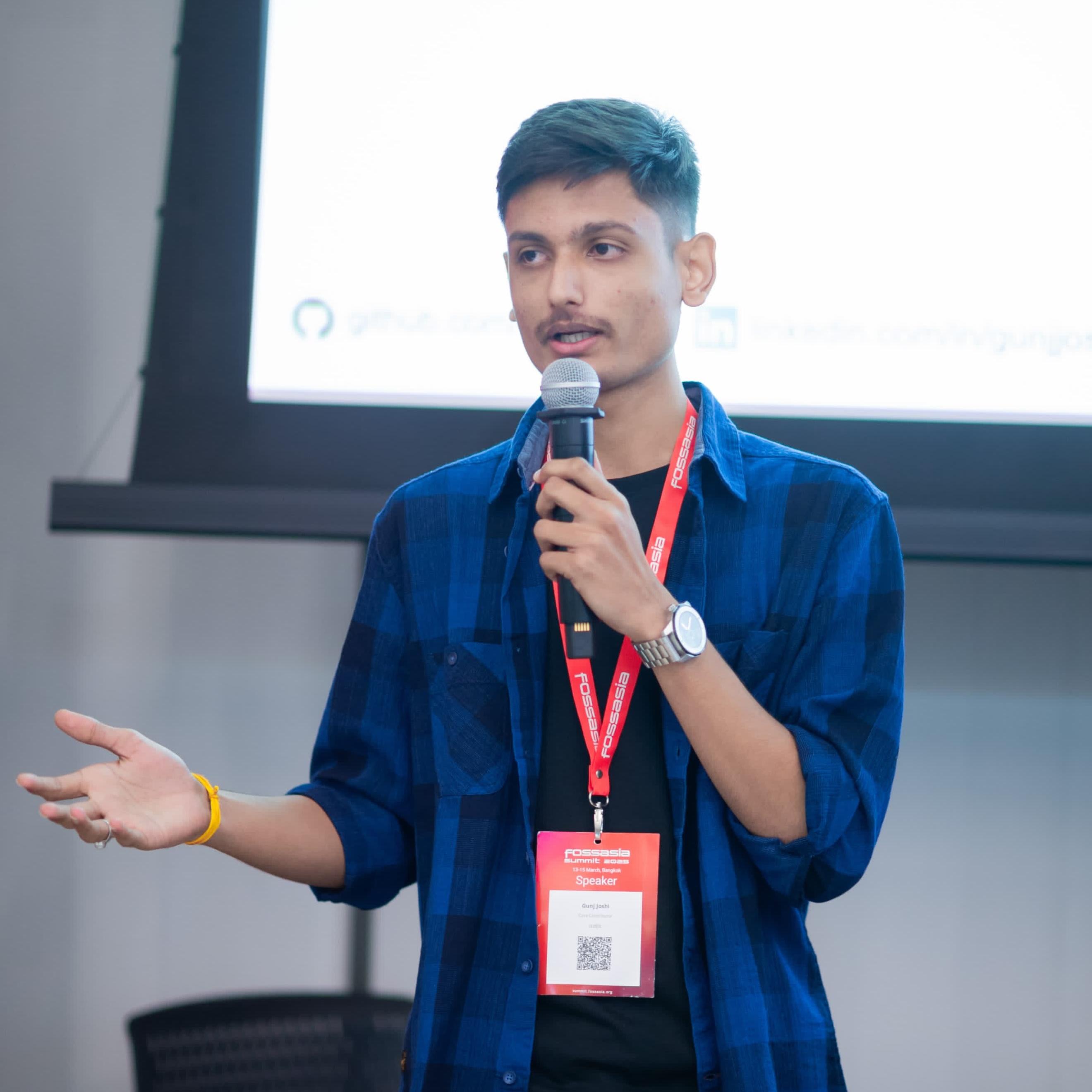
Gunj Joshi
Core Contributor stdlib
linkedin.com/in/gunjjoshi
Gunj Joshi

Reviews

0 %
Approvability
0
Approvals
0
Rejections
2
Not Sure

Hello, this is an interesting project and worth learning about. The way it is written doesn't seem to highlight any of the open source nature of the project. I think if this was written from a different angle like, "how we can break the Matlab monopoly with the browser" or something like that it would be more compelling to be on the main stage of a national FOSS conference. I don't feel like out audience will see the implications of this project without some explanation on why you think this project is important and compelling and a valuable addition to the FOSS ecosystem. The ability to run code and computation in the browser is not new or novel, so this needs to be more than "we figured out how to do wasm without doing wasm" but more specific to why it's a big deal that you can you do mathematical analysis easily within the browser with no dependencies or setup. How this significantly increases accessibility to serious computational tools and all the further implications of having a lower barrier to entry for doing computation, the ubiquity of web browsers, etc.

Reviewer #1
Not Sure

Agreed with the other reviewer. I think there is value in the talk and some good changes can be made to this proposal. Leaning towards rejection in case we are not able to reach out to proposer due to time constsraints

Reviewer #2
Not Sure