Skip to Main Content
Talk Beginner CC BY-SA 4.0 (open data/documentation)

It’s Just a Video Call… Right? Understanding WebRTC Under the Hood

Proposal status is Review Pending
Shane Cardoz
Shane Cardoz
Session Description

Proposal Description

What really happens when you join a video call?

We use video conferencing almost every day, but the journey from clicking “Join” to seeing and hearing someone in real time involves a surprisingly complex set of technologies.

In this talk, we’ll take a practical journey through a real-time video call and explore how WebRTC makes it possible. Starting from the moment a user joins a meeting, we’ll follow the flow through signaling, connection establishment, NAT traversal, media capture, encoding, RTP/RTCP, encryption, and finally the delivery of audio and video to other participants.

We’ll also look at why direct peer-to-peer communication does not scale well for larger meetings and how Selective Forwarding Units (SFUs) help build scalable conferencing systems. Along the way, we’ll explore concepts such as STUN, TURN, ICE, SDP, simulcast, congestion control, packet loss, jitter, and bitrate adaptation.

The talk is based on practical engineering investigation and experimentation with real-time communication systems. Rather than focusing only on specifications and theory, the goal is to understand what actually happens on the wire and inside a modern conferencing architecture.

By the end of the session, attendees should have a clear mental model of how a video call travels from camera → network → media infrastructure → other participants, and a better understanding of the technologies that power modern real-time communication.

The talk will also highlight open-source technologies and projects that can be explored by anyone interested in building or understanding WebRTC-based systems.

Key Takeaways

Key Takeaways

By the end of the talk, attendees will:

  1. Understand what happens when you join a video call, from the initial connection to receiving audio and video.
  2. Build a clear mental model of the WebRTC call flow, including signaling, SDP, ICE, STUN, and TURN.
  3. Understand how audio and video travel across the network, including media capture, encoding, RTP/RTCP, and encryption.
  4. Learn why peer-to-peer communication doesn't scale for large meetings and how SFUs solve this problem.
  5. Understand the basics of simulcast, bitrate adaptation, congestion control, packet loss, jitter, and latency.
  6. Learn how to use WebRTC statistics and network-level observations to investigate what is happening during a real-time call.
  7. Understand the difference between WebRTC as a communication technology and the larger architecture required to build a production-grade conferencing system.
  8. Get introduced to open-source WebRTC and media-server projects that they can explore and experiment with themselves.

References

Session Categories

Technology architecture
Engineering practice - productivity, debugging
Knowledge Commons (Open Hardware, Open Science, Open Data etc.)
Talk License: CC BY-SA 4.0 (open data/documentation)

Speakers

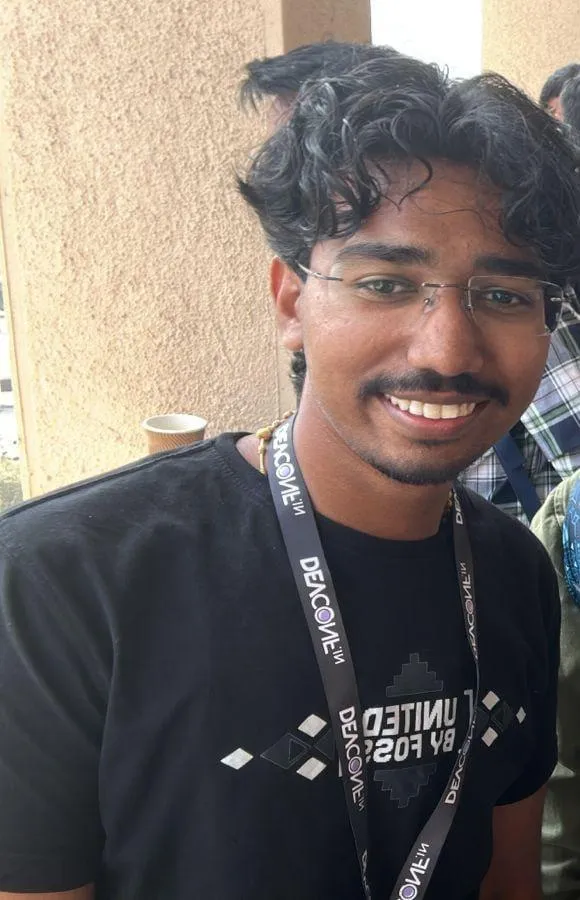
Shane Cardoz Maria WebRTC & Real-Time Systems Engineer | Rittly

Finally touched the grass. ❤️FreeBSD

Shane Cardoz Maria
https://www.linkedin.com/in/shane-cardoz-m