Notes from the Asia Pacific Regional IGF 2026
From the Asia Pacific Youth Internet Governance Forum (October 3–4) and the Asia Pacific Regional Internet Governance Forum (October 4–7).
I attended the Asia Pacific Youth Internet Governance Forum (October 3–4) and the Asia Pacific Regional Internet Governance Forum (October 4–7).
The IGF is a UN-convened forum where governments, companies, civil society and technologists discuss how the internet is run and used. This year’s APrIGF theme was “Safeguarding a Resilient Internet in Times of Crisis”; the youth summit’s was “From Users to Stakeholders: Youth Shaping Resilient and Rights-Based Digital Futures.”
The first few days at the youth summit gave me the opportunity to meet young people across Asia Pacific. Panelists, throughout the two days of sessions and activities, kept returning to tokenism. Young people can be represented on a panel without having any influence on the outcome. Participants also wanted follow-up after events like these, so they could see whether their input changed anything. The yIGF working document will be linked here when it’s public.
In a crisis-simulation exercise on AI and misinformation, my group had participants from Nepal, India, South Korea, Taiwan and the Philippines. We worked out which institutions need to coordinate in an emergency and who is responsible for checking misinformation. We also looked at how badly written prompts can generate fear, and how generative AI might translate emergency messages faster and push them out as soon as an event happens. Ideas included localised servers for critical information, a system run by a larger body (most suggested the government) with local centres and a brief discussion of where open source fits. The latter was not discussed in detail and mentioned in passing. The local-centres idea was really about decentralisation, and “centres” could also mean people near the affected area. But most of the conversation assumed AI was a neutral tool, and we never asked whether the systems we were rooting for already existed. I wish we had spent more time studying how crisis governance actually works across the Asia Pacific.
I also attended “The Cost of a Click” by The Pranava Institute, and used their Unboxing Tech Toolkit [link] to map where the fastest internet servers sit. It asked where young people host public repositories, what that costs ecologically, and where the internet physically lands. It’s a useful corrective to treating “the cloud” or “open” as placeless.
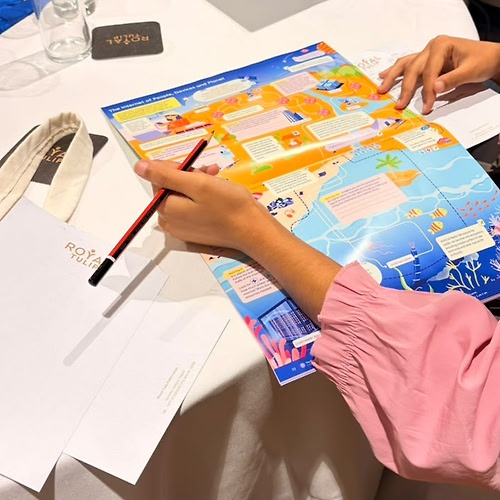
A participant using Unboxing Tech Toolkit at APrIGF 2026
The session “Surveillance by Design: Digital ID, Data Protection and the Trust Crisis in South Asia” (by Factum and Aapti Institute) argued that South Asia is building digital ID and data systems faster than the laws meant to protect people from them. Surveillance gets designed into the architecture before any regulator looks at it, which makes it a problem. Open, auditable code makes oversight possible, but someone still has to do the auditing, and there has to be a legal route to act on what they find.
Lastly, Freedom Online Coalition moderated a panel which suggested the existing FOC members (India is not a part of it, yet) to engage with more country specific issues. Participants criticised blanket social media bans for youth, including in Nepal. They pointed out that shutdowns and surveillance against youth-led protests are not protection for young people. Participants also warned against selective multistakeholderism and English-only policy spaces, both of which can create a false sense of agency.
Threads to pick up:
- With Yash Aggarwal (founder of Public Policy India; Engagement Manager for South Asia at ICANN), I discussed whether open source could help school students understand policy. If the information is open, can students question policies and propose changes?
- Isabelle Lois, who is helping manage the AI Summit 2027 in Geneva, and I compared notes on scholarship processes, drawing on how IndiaFOSS ran its own. We agreed that AI research needs people from interdisciplinary backgrounds.
- October was Open Source Hardware Month, and I kept thinking about how to bring people and conversations from IGF meetups into makerspaces, and vice versa. This probably needs ideas from the Indian FOSS community and makerspaces themselves.
- Vatsla Srivastava, President of Internet Society India, Mumbai Chapter, was one of the fellows from India. I was excited to hear about Mumbai IGF, which had recently taken place in September.
Digital commons came up across panels as the default good. APrIGF brought together a lot of organisations, people and ideas about what the internet should be. Patan, where I was staying, offered a concrete version of the idea. It has shared courtyards and communal water spouts, spaces where work, travel and daily life overlap. They stay usable because people share responsibility for maintaining them. Digital commons work the same way. Internet governance is where many of the rules for those commons get decided.
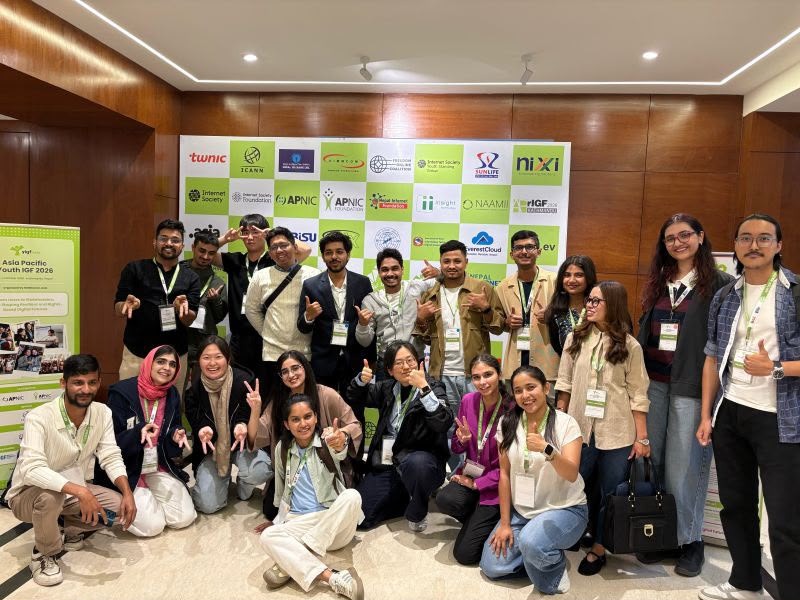
(A few of) the participants of APyIGF 2026
No comments yet. Login to start a new discussion Start a new discussion